
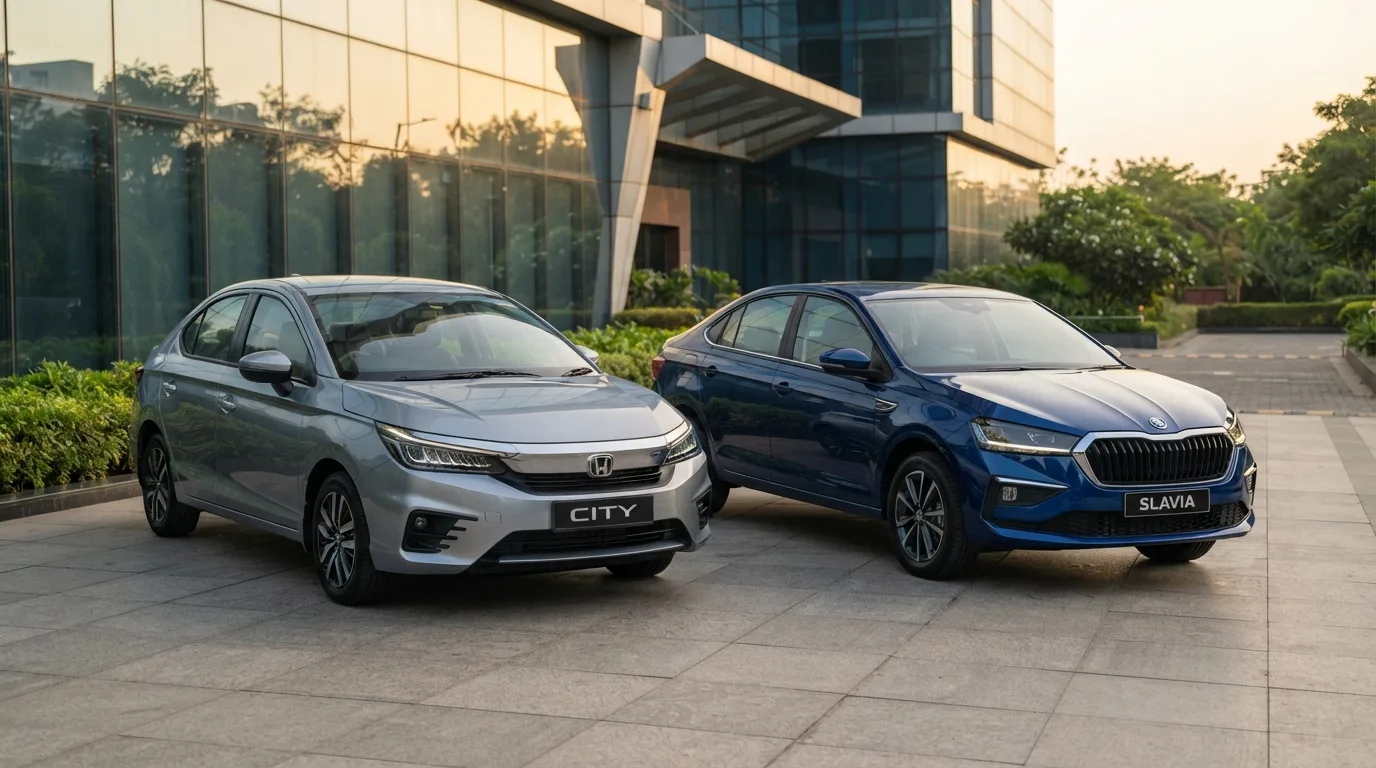
Sedans aren’t as trendy as SUVs anymore, but if you’ve actually driven a few, you know why buyers still swear by them. Two names keep coming up in this segment right now: the Honda City and the Skoda Slavia. One leans on reliability and comfort, the other on turbo power and European road manners. Both are genuinely good cars, so the “better” one really depends on what you drive for and how long you plan to keep it.
We spent time going through specs, dealer feedback, and real ownership experiences to put together this Honda City vs Skoda Slavia 2026 comparison, so you’re not just reading marketing lines but getting a practical view of where each car actually stands.
Quick Comparison Table
| Feature | Honda City | Skoda Slavia |
|---|---|---|
| Engine Options | 1.5L NA Petrol | 1.0L Turbo Petrol & 1.5L Turbo Petrol |
| Power | 121 PS | 115 PS / 150 PS |
| Transmission | 6MT, CVT | 6MT, 6AT, 7DSG |
| Claimed Mileage | Up to 18.4 km/l | Up to 20.3 km/l |
| Boot Space | 506 litres | 521 litres |
| Ground Clearance | 165 mm | 179 mm |
| ADAS | Available | Not Available |
| Starting Price (Approx.) | ₹12 lakh | ₹11.7 lakh |
Design: Classic vs Sporty
The City still plays it safe with a clean chrome grille, sharp LED lamps, and proportions that age well. It’s the kind of car that won’t look outdated in five years. The Slavia takes the opposite route with a bolder front end, a coupe-like roofline, and alloy wheels that give it a sportier stance. If you like being noticed, the Slavia wins. If you’d rather have understated elegance, the City has the edge.
Engine and Performance: Where the Real Difference Lies
This is the biggest talking point between the two, honestly. The Honda City runs a naturally aspirated 1.5-litre i-VTEC petrol engine making 121 PS and 145 Nm, smooth, predictable, and easy to live with day to day, especially with the CVT in city traffic.
The Slavia gives you a choice: a 1.0-litre TSI (115 PS, 178 Nm) or a punchier 1.5-litre TSI (150 PS, 250 Nm) paired with a 7-speed DSG. On the highway, the 1.5 TSI genuinely feels quicker and more eager than the City. If overtaking confidence and highway pace matter to you, the Slavia is the more exciting drive.
Ride, Handling, and Everyday Comfort
Here’s where personal preference really kicks in. The City’s suspension is tuned soft, so it soaks up potholes and rough patches without unsettling passengers, a big plus if you’re chauffeur-driven or carry family often. The Slavia is stiffer and more communicative through corners, which enthusiasts will enjoy, but it can feel slightly firmer over bad roads.
Interior, Features, and Safety
Both cabins feel premium, but Honda has pulled ahead on one important front: ADAS (Honda Sensing), which includes adaptive cruise control, lane-keep assist, and collision mitigation braking. The Slavia doesn’t offer this yet, which is worth noting if driver-assist tech is a priority for you.
| Safety Feature | Honda City | Skoda Slavia |
|---|---|---|
| Six Airbags | Yes | Yes |
| ESC | Yes | Yes |
| ABS with EBD | Yes | Yes |
| Hill Hold Assist | Yes | Yes |
| TPMS | Yes | Yes |
| ADAS | Yes | No |
| Rear Camera | Yes | Yes |
Both offer wireless smartphone connectivity, ventilated seats, sunroofs, and digital instrument clusters, so neither feels short on features.
Space, Mileage, and Running Costs
The City’s rear seat remains one of the most spacious in its class legroom is genuinely class-leading. The Slavia counters with a slightly bigger 521-litre boot and better ground clearance at 179 mm, which helps on uneven roads.
On running costs, the City’s simple NA engine tends to be cheaper to maintain long-term. The Slavia’s turbo-petrol engines are efficient, especially the 1.0 TSI, but turbocharged engines and the DSG gearbox can add to servicing costs down the line.
Recommendation
If you want a stress-free ownership experience, a comfortable back seat, and modern safety tech, the Honda City makes more practical sense, especially for families.
If you enjoy driving, want stronger highway performance, and like standing out a bit more, the Skoda Slavia is the more rewarding choice, and arguably the better value pick given its lower starting price and turbo-petrol punch.
There’s no universally “correct” answer here; both are solid, well-built sedans. The right one depends on whether you prioritize comfort and reliability, or performance and driving engagement.