
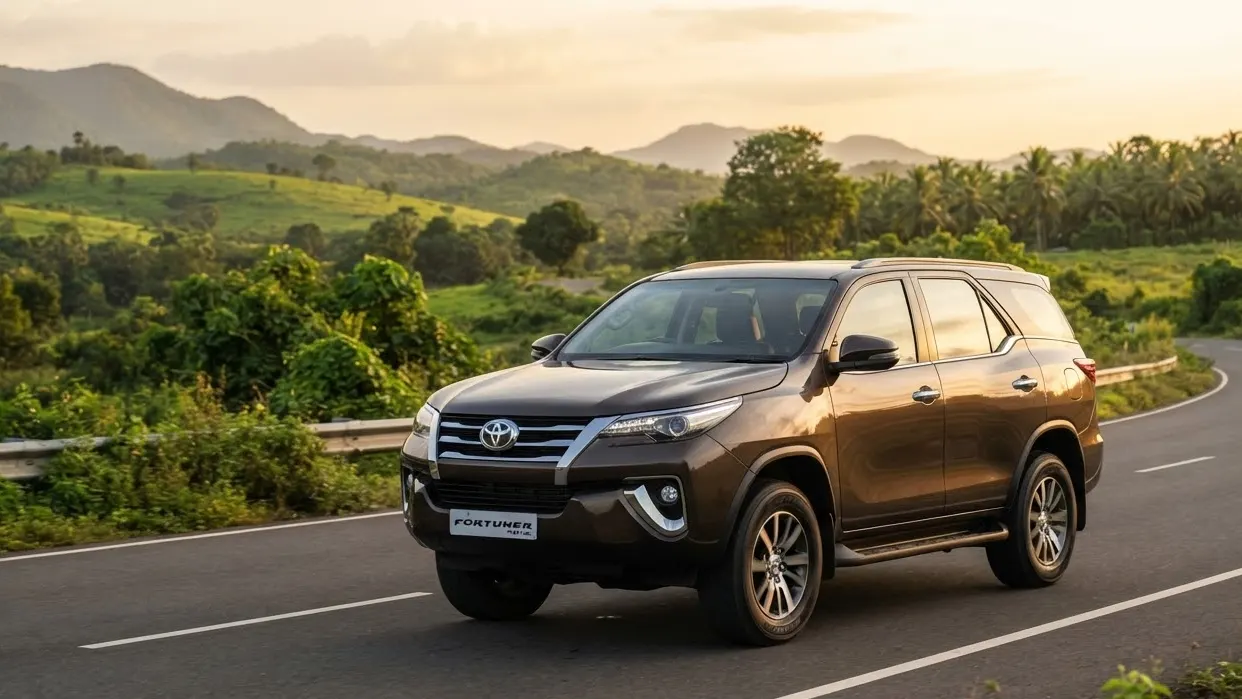
Toyota has been quietly rewriting the rulebook for SUVs, and the Fortuner Flex Fuel is one of its most interesting experiments yet. First showcased at the Gaikindo Indonesia International Auto Show (GIIAS) in Jakarta, this prototype continues to shape conversations at Indonesian motor shows and eco-mobility exhibitions heading into 2026, as the country pushes harder on biofuel adoption and carbon-neutral transport goals.
What Makes the Fortuner Flex Fuel Different
Unlike a regular Fortuner, this version is engineered to run on E-100 fuel, pure 100 percent bioethanol. At the heart of the prototype is a reworked 2.7-litre, four-cylinder petrol engine, the same base unit familiar to Fortuner buyers in markets like India. Toyota’s engineers modified the fuel system and reprogrammed the ECU to handle ethanol, which is more corrosive than conventional petrol and needs a different calibration to run cleanly and reliably.

Performance-wise, the flex-fuel unit produces around 163 hp and 243 Nm of torque, only a marginal drop compared to the standard petrol version’s output. That’s a strong signal: switching to a greener fuel source doesn’t have to mean sacrificing the driving character SUV buyers expect. Power reaches the rear wheels through a familiar 6-speed automatic transmission, keeping the driving experience largely unchanged from the regular Fortuner.
Why Indonesia Is the Testing Ground
Indonesia makes a lot of sense as the proving ground for this technology. The country has abundant agricultural resources for ethanol production, a large automotive manufacturing base through Toyota Motor Manufacturing Indonesia (TMMIN), and a government policy actively encouraging multi-pathway carbon reduction strategies. Toyota’s broader “Beyond Zero” philosophy, spanning hybrids, biofuels, hydrogen, and battery EVs, has been showcased repeatedly at Indonesian eco-mobility events, reinforcing that no single technology will solve emissions challenges everywhere. Flex-fuel vehicles offer a practical middle path for markets where charging infrastructure for EVs is still developing but where combustion-engine SUVs remain hugely popular.
A Design That Doesn’t Sacrifice Practicality
From the outside, the Fortuner Flex Fuel prototype looks nearly identical to the standard model, aside from special livery highlighting its eco-credentials. That’s intentional. Toyota’s approach isn’t to reinvent the SUV but to prove that existing, beloved models can be adapted to burn cleaner fuel without a bulky redesign or expensive new platform. For a vehicle as commercially important as the Fortuner, a top-seller across Southeast Asia and beyond, that’s a pragmatic strategy.
What This Means for the Road Ahead

With Toyota simultaneously developing a next-generation Fortuner (expected to share underpinnings with the latest Hilux), there’s real curiosity about whether flex-fuel capability could eventually migrate into production variants. Toyota has already piloted related flex-fuel hybrid technology on other models, suggesting the automaker sees ethanol compatibility as a genuine part of its long-term powertrain strategy rather than a one-off show display.
Wrapping Up
The Toyota Fortuner Flex Fuel isn’t just a concept for an auto-show spectacle. It represents a practical, incremental approach to decarbonizing SUVs in markets where full electrification isn’t yet realistic. By reusing an existing platform and engine architecture, Toyota shows that sustainability and familiarity don’t have to be at odds. As Indonesia continues championing biofuel innovation on the global motor show stage, expect the Fortuner Flex Fuel and vehicles like it to remain part of the conversation for years to come.